Tuesday, March 17, 2015

This Is Your Brain On(line)


Living in the age of digital technology as a student, employee, newlywed and home owner, my responsibilities are scattered, overflowing and overlapping. Whether I’m at work, school, or home, the Internet has a way of keeping me unceasingly connected to all the areas of my life, whether I like it or not. My iPhone is connected to 3 different email accounts; work, school, and personal, my TV, my MacBook, my calendar, my shopping list, Facebook and ultimately my brain. No matter where I am at any given point in my day I get to bring everything with me. Some people would call this convenient, but recently I have started to see it as a burden.
     
My iPhone has this neat little feature called the off button. Supposedly I can turn it off and no longer be bothered or distracted by the limitless stream of information that is constantly flowing through it. One minute I can be simultaneously reading an email from my boss, listening to my favorite song, while downloading the criteria for my final paper and receiving a text from my mom asking for the hundredth time how she can add an attachment to an email; the next minute, BOOM, nothing. In theory, with just a swift tap of the off button I am successfully disconnected, undistracted, and on my way to some peace and quiet.  My brain, on the other hand, doesn’t have such an obvious off button and long after I unplug, my head is still on overdrive trying to sort through all of the information my super smart phone and Google just left me with.
     
Just for fun, the next time you open one of your devices to do something, take a look at the clock. When you finally put your device down, look at your clock again, more importantly look at your browser history. How off track did you get, how quickly, and for how long? What were you originally planning to do when you realized that you had just watched 17 YouTube videos instead? A few weeks ago I realized by brain works a lot like Siri. I went to check the spring break schedule for the college online and my brain prompted, “Did you mean, "Which beach do you wish you were on for spring break?"” Two minutes later, instead of looking at my schedule I’m on the Travel Channel’s website reading about the top Caribbean destinations of 2015. 

This was the process that my brain underwent in trying to find one simple weather forecast:

I must admit that this is a condensed version of how many places my brain trailed off over the course of looking at the weather. So in this digital age that we are living in, how do we take advantage of the amazing tools that technology has to offer without being completely blissfully distracted by it? I wish that I could give you a hard and fast answer, but truthfully I’m still trying to find the balance myself. I find that even being aware and mindful of my time spent online, as I so successfully illustrated above, is the first step to evaluating what I can do (or NOT do) to maintain focus.
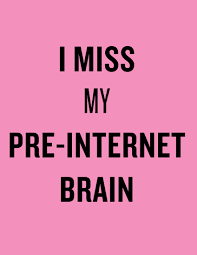

So how immersed are you in technology?   Have you found a balance where you can use the tools on your devices efficiently, but you aren’t at the point where you are dropping your phone on your face at bedtime? If you know the phone to face scenario all too well, it might be time to limit your tech time. At the end of the day we have to ask ourselves, “Is falling asleep while looking through my Twitter feed really #WorthIt to suffer a hairline fracture to my nose?”I challenge you to really take a look at how “plugged-in” you really are and to make an effort to not be at the mercy of the latest trending story. Perhaps start by asking yourself, “What was I intending to do before I stumbled upon this blog post?”

Please share your own thoughts surrounding this topic, tips you use to stay on task and mindful of your tech behaviors, or your overall opinion on technology in our society today.  How much time do you spend online per day, and what does that time look like for you? Thanks for reading, congratulations if you read this all the way to the end, you’re on your way to becoming more focused! 


Alex Claus, writer of this post is the marketing intern at Kalamazoo Valley Community College.

Monday, February 23, 2015

Hipsters, Millennials and Sustainability: What do they mean in Kalamazoo?

On par with hipster and millennial, sustainability has become a buzzword. From high profile environmental and socioeconomic discussions all the way down to the “Top 10 Power Foods to Eat Before a Workout” type articles you scroll through on BuzzFeed, it seems pretty unanimous that sustainability equals success. With the increasing use of the buzzword as a description, the term sustainability seems over used and under explained. I figured the best way to break it down is to look at what exactly sustainability means and might look like right here in Kalamazoo, Michigan.


When you type any of the three words into your Google search bar, collectively you get precisely one billion, seventy million, seven hundred thousand results, in about 2.5 seconds. This puts Encarta to shame, as cutting edge as it was in ‘96, Ask Jeeves stole the show. I think it’s safe to say we all knew “Encarta it” would never be a thing. Hipsters and millennials, like many other cultural and generational groups, have gained somewhat negative stereotypes. One article entitled “Millennial Generation aka Generation Me,” questions whether Millennials are self-entitled narcissists or open-minded do-gooders. This seems like a harsh generalization to apply to a whole generation of people born between the years of 1981 and 2000. Contrary to popular belief, we don’t all take selfies with our dinner plates just to post on Instagram.
Hipsters have inherited similarly bad stereotypical raps.

Disregarding the negative labels for a moment, looking at the overall intentions of the interrelated groups, it is my belief that they have a very powerful and relevant message to share. Millennials and hipsters alike have been recognized as not accepting what is or has been, but rather looking at current issues and challenging the conventional with fresh and progressive perspectives. I am not saying that this way of thinking and living is exclusively of one generation or group of people. I would simply like to draw the parallel between the current cultural trends and how they are moving swiftly into a direction that fosters sustainability.

So other than being recognized in pop-culture how does this all tie together to promote sustainability, specifically in Kalamazoo? The thriving locally sourced culture is embraced by Kalamazoo in several ways. Starting with the hops that are grown for the beer that is brewed here, Kalamazoo Valley will take locally sourcing to the next level and launch its Sustainable Brewing Degree Program.

We’re not the new kids on the block when it comes to sustainable programs in Kalamazoo. The nationally recognized Kalamazoo Promise scholarship is a "Proper" example of community coming together to make education sustainable. Sustainable and innovative thinking and living shouldn't be limited as a generational movement but instead, an all-encompassing mindset that all communities should adopt.

In the spirit of sustainability, we want to talk about what’s relevant today and keep the conversations going. What does sustainability mean to you? Follow our new blog at kalamazoovalley.blogspot.com Thanks for reading.


Alex Claus, writer of this post is the marketing intern at Kalamazoo Valley Community College.